Can Banks Read a Forest?

Why Nature Finance Needs Ecological Judgment
In 2022, Bank Negara Malaysia and the World Bank published An Exploration of Nature-Related Financial Risks in Malaysia, which I will call the NRFR report. It was an act of translation. It carried forests, water, soil and biodiversity into the language bankers use for credit exposure and transition risk. It is an important piece of work. Without that translation, nature stays outside the room where capital is allocated.
Yet translation also distorts. Meaning slips unless a native speaker checks the text, and for nature the native speakers are ecologists, hydrologists, soil scientists and foresters.
Take one example. The NRFR report sometimes asks what would happen if an ecosystem service ‘defaulted’. A borrower defaults on a date that can be written into a file. A forest rarely fails so neatly. Its soils may lose nutrients gradually. Its litter layer may thin. Runoff and sediment may increase, and seed sources may disappear. For years the forest canopy may stay green. Then the combined losses tip it into a different state, and the default arrives without a date.
That gap between a loan file and a forest begins with method. The report starts by mapping sector-coded bank lending against global ecosystem-service ratings. Its spatial analysis then links postal-code lending points to Key Biodiversity Areas. Both steps read a living ecological system with the tools of finance.
To test whether the translation is grammatical, I returned to Vanishing Rain Forests, the classic study of Malaysia’s ‘nature’ by the physical geographers Robert Aiken and Colin Leigh. It shows why exposure cannot be read from a sector code or a postal coordinate alone. Peninsular Malaysian forests vary with parent rock, drainage, altitude and soil (page 40). Their hydrology runs through catchments that cut across property lines. Their biodiversity is organised through a shifting mosaic of gaps, building forest and mature forest (page 43). Two hectares under the same postal code can do very different ecological work and recover at very different speeds. Telling them apart takes a field ecologist.
The same blind spot affects the report's maps, which can mislead by reassuring. The report says the share of commercial lending identified in non-protected Key Biodiversity Areas is “relatively small” and suggests that “first-order spatial transition risk might not be as problematic” (page 44). That conclusion rests on a spatial sample covering about 5% of commercial lending, and it locates each loan by a postal-code point that misses most of the asset's footprint. The dataset may also omit supply chains, unmapped lowland fragments, ecological corridors and upstream processes supporting distant economic activity. A blank patch on a risk layer may still be feeding the river that a borrower downstream depends on.
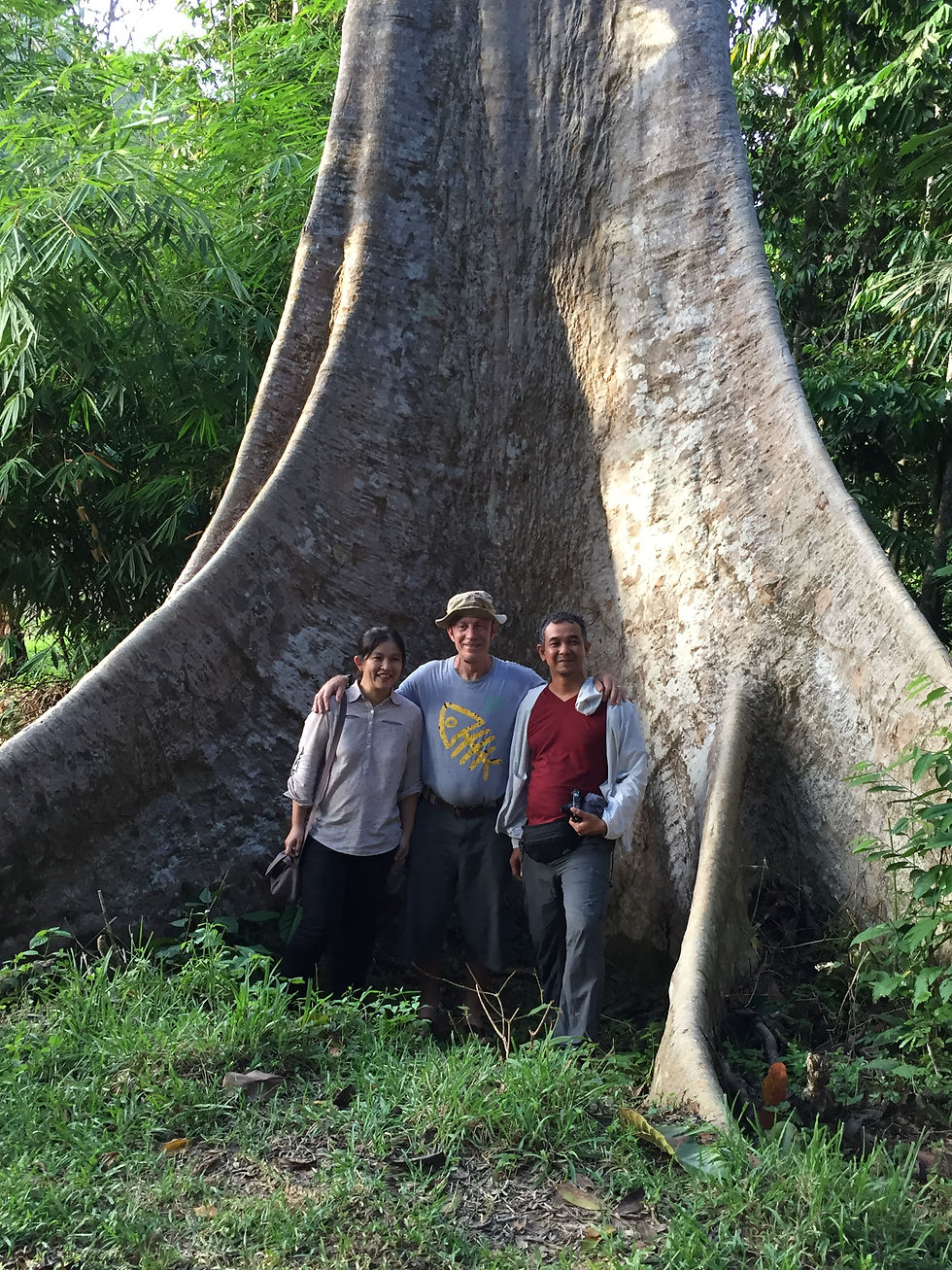
Flood protection carries the same warning. The report says that “flood and storm protection is becoming increasingly important as climate change grows” (page 35) and later describes extreme-weather disruptions “that could be moderated by intact rainforests and mangroves” (page 85). Neither statement is wrong, but together they can be read too broadly. Aiken and Leigh report that Malaysia’s forested catchments generally had lower runoff. During prolonged, high-intensity storms, runoff was probably similar across land-cover types, and flooding struck forested and non-forested catchments alike. They also linked landslide risk to storm intensity and susceptible geology. Finance should credit the forest for moderating floods while still pricing the storms it cannot stop.
For banks, the lesson is practical. Financial measurement needs ecological discipline, and that discipline has to come from people trained in the sciences. A material exposure should be accompanied by an account of forest type, soil, geology, catchment, condition, connectivity and regenerative capacity. Scenarios should model slow deterioration and tipping thresholds, along with recovery periods that run longer than the loan. Banks without this expertise in-house should hire it or partner for it, as they would bring in an engineer to assess a power plant.
Nature belongs on the balance sheet, agreed. However, getting it there accurately takes people who can read a forest as well as a credit file. Islamic banks already accept that a Shariah committee must certify what financial analysis alone cannot judge. Should nature-related lending have a committee of ecological scientists?
Dr Hezri Adnan has held senior executive roles at a development authority, an economic think tank, and a stock exchange. He now leads Choras Advisory, an independent consulting practice.


Comments