Playing 'tai chi' with floodwater

Last Friday, rising waters flooded central Johor Bahru, with images of knee-high floods in Nong Chik, Jalan Kolam Ayer, and Tasik Merdeka circulating on Socmed. The flooding threat is far from over as we expect high tide tonight (17 December 2025) to trigger fresh flooding in low-lying areas. In fact, JB, like many coastal areas, sometimes faces a tug-of-war between monsoon rainwater and the rising tides.
Over the decades, the Malaysian government has taken significant steps to mitigate flooding in the city. Our best engineers have built many concrete drainage systems and other civil engineering solutions. Earlier this year, Gomen announced that there are 11 ‘tebatan banjir’ projects in the state. However, the ‘water bombs’ phenomenon - the sudden intense rains - defeats the city of JB again and again.
Therefore, it is refreshing that in May 2025, the Pengerusi of JK Kerjaraya, Pengangkutan, Infrastruktur dan Komunikasi announced that the State is exploring the use of ‘Sponge City’ to address flooding through nature-based solutions.
Yes the the sky is angry by showering us with more than we can handle, but have we stopped to ask where the water should go? Year in, year out, we built our cities the way most cities get built: roads first, buildings next, (then .. ehem… data centres). Water? Air hujan? Alamak water ... we’ll figure it out later.
This city like most cities are not designed with water logic. Geographically, JB is a city of flatness, shallow basins and tidal influence. In pursuit of economic development, we buried and straightened our rivers to channel floodwater to the sea as quickly as possible. Then our highways cut through like walls. As a result, drains choked at every turn. And places like Stulang in JB became like mee tarik bowls waiting to fill teh tarik water . So when heavy rain meets high tide, and the rivers push back pulak, it’s geometry la, meranduk banjir lah kita.
What the Johor EXCO was saying is that, the fix isn't bigger drains or taller walls. We need to rethink the entire system and think like water. What JB needs is to become a sponge city that slows water, holds it for a while, then releases it gently across the flat landscape. Storage is key; JB needs many shallow retention spaces like parks, permeable fields and wetlands. In some cities, sponge designs can reduce peak river flows by 65% and one hectare of green sponge can clean about 800 cubic metres of water.
In the words of the sponge city pioneer, Prof Kongjian Yu, we should not indulge in "boxing with water" by building ever-bigger drains and higher walls. Floodwater is powerful, fighting it often makes things worse. Instead, we should learn to play tai chi with water, letting it enter the city, but on our terms. In hundreds of sponge cities worldwide, planners slow water down, give it space to pause, breathe, and gently guide it away. They live with water, not fear it.
Let’s allow our imagination to run wild by envisioning some sponge design ideas for JB:
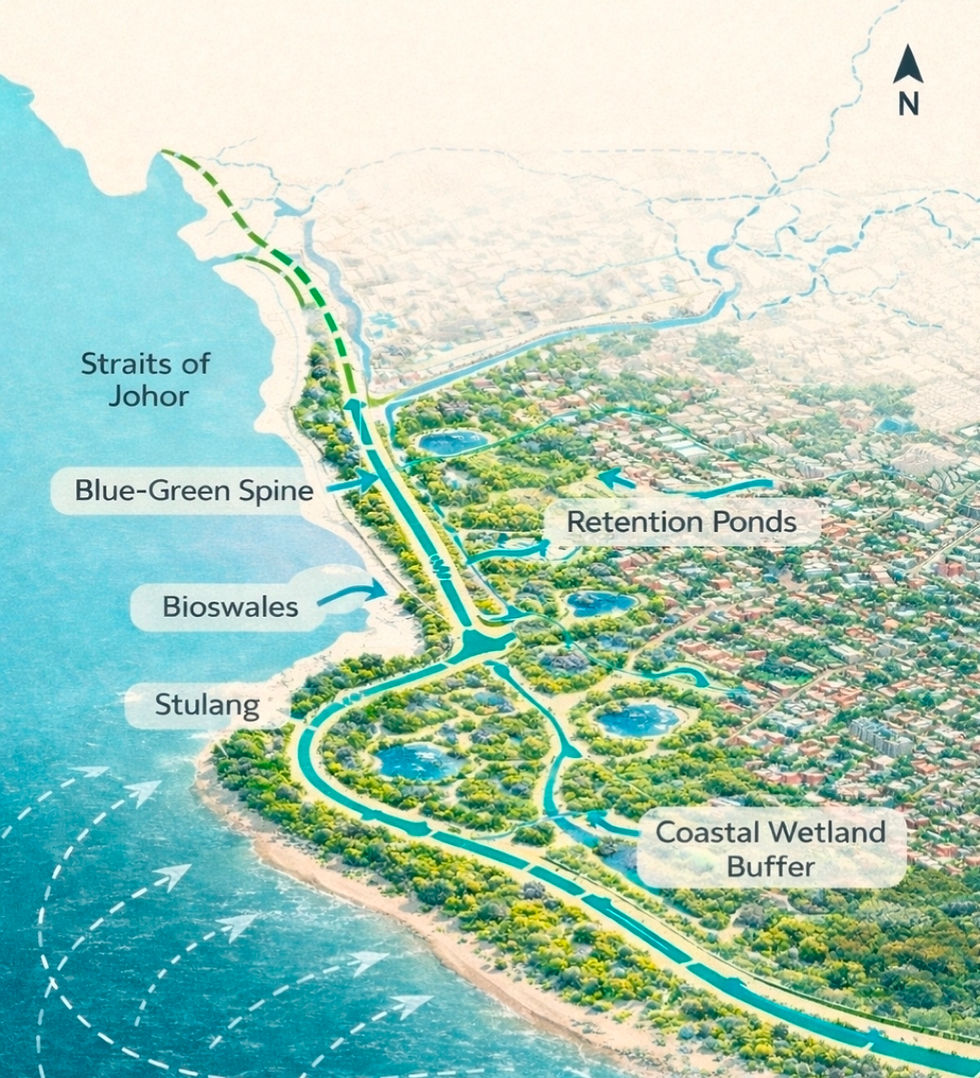
A blue-green corridor running parallel to the coast and highways, from Danga Bay towards Pasir Gudang, catching runoff before it inundates the neighbourhoods such as Stulang, Larkin and Taman Molek.
Bioswales along roads such as the Tebrau and Skudai highways that soak up stormwater instead of funnelling it underground.
Retention ponds scattered through the city in flood-prone areas like Taman Sentosa to hold monsoon rain when it peaks, then release it slowly.
A coastal buffer zone with mangroves and wetlands stretching from Danga Bay to the eastern shoreline, where tidal surges and river overflow can spread out safely without crashing into concrete. The coastline must act like a giant pressure-release valve that accepts water when rivers and drains can no longer discharge.
These are merely general ideas. To move forward, the decision-makers in Johor need to target critical areas in the state for sponge city applications using the 'ecological acupuncture' strategy.
If you search for sponge city designs online, they are mostly visually stunning and can potentially increase the value of the surrounding land and property. Check out the Benjakitti Forest Park in Bangkok. Believe it or not, it was an ugly industrial site turned into a heavenly urban sanctuary in just 18 months, thanks to the Thai military working hard during the Covid-19 lockdown.
However, Sponge City is about more than just aesthetics. Instead, it is about allowing water to flow naturally without causing destruction.
Flooding will always happen here. Yes, we're coastal and tropical. That's our reality, and geography is destiny.
But recurrent damage by flooding? That's a choice. So, how best to dance in the rain is something we need to decide really soon.


Comments